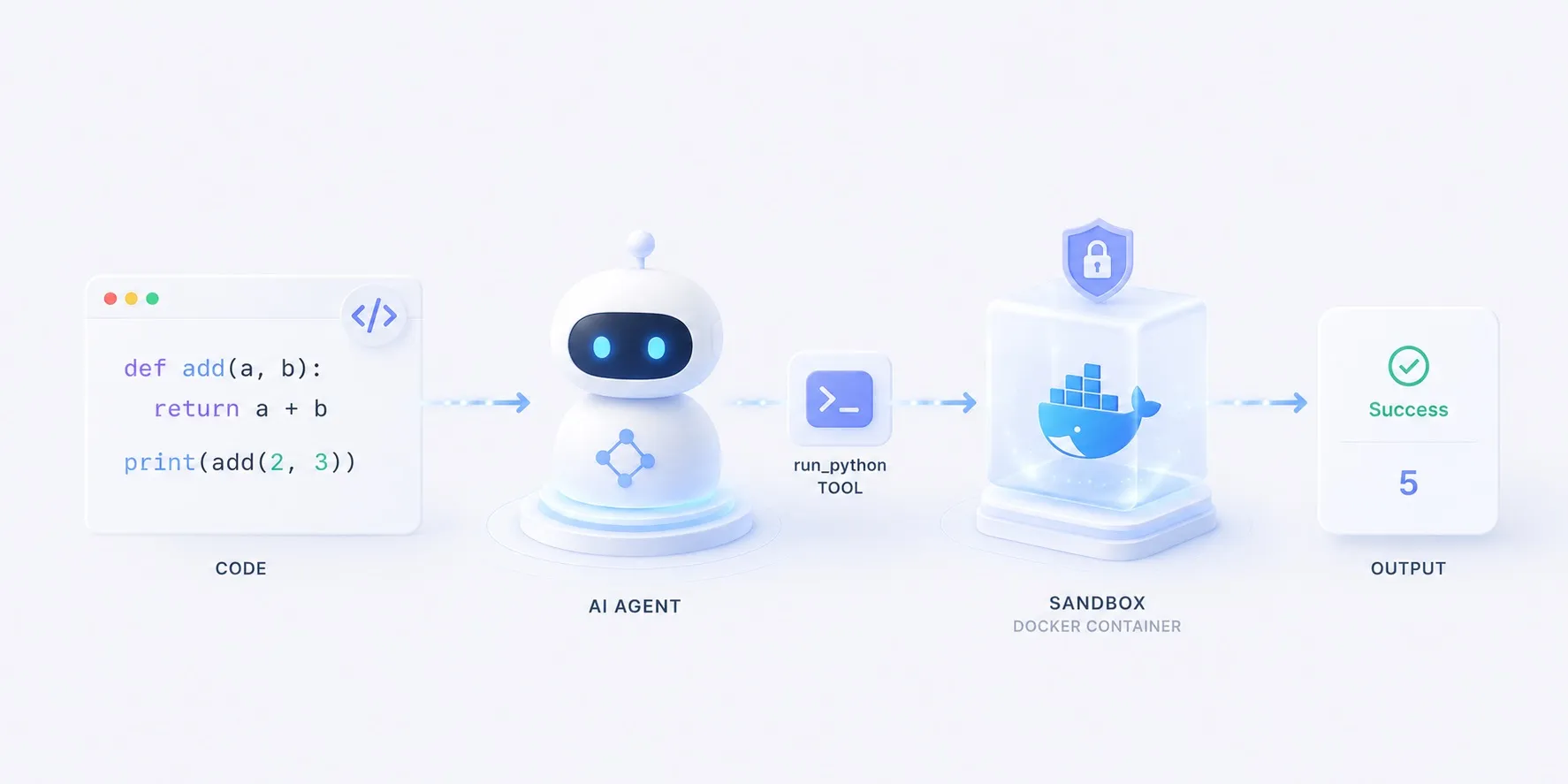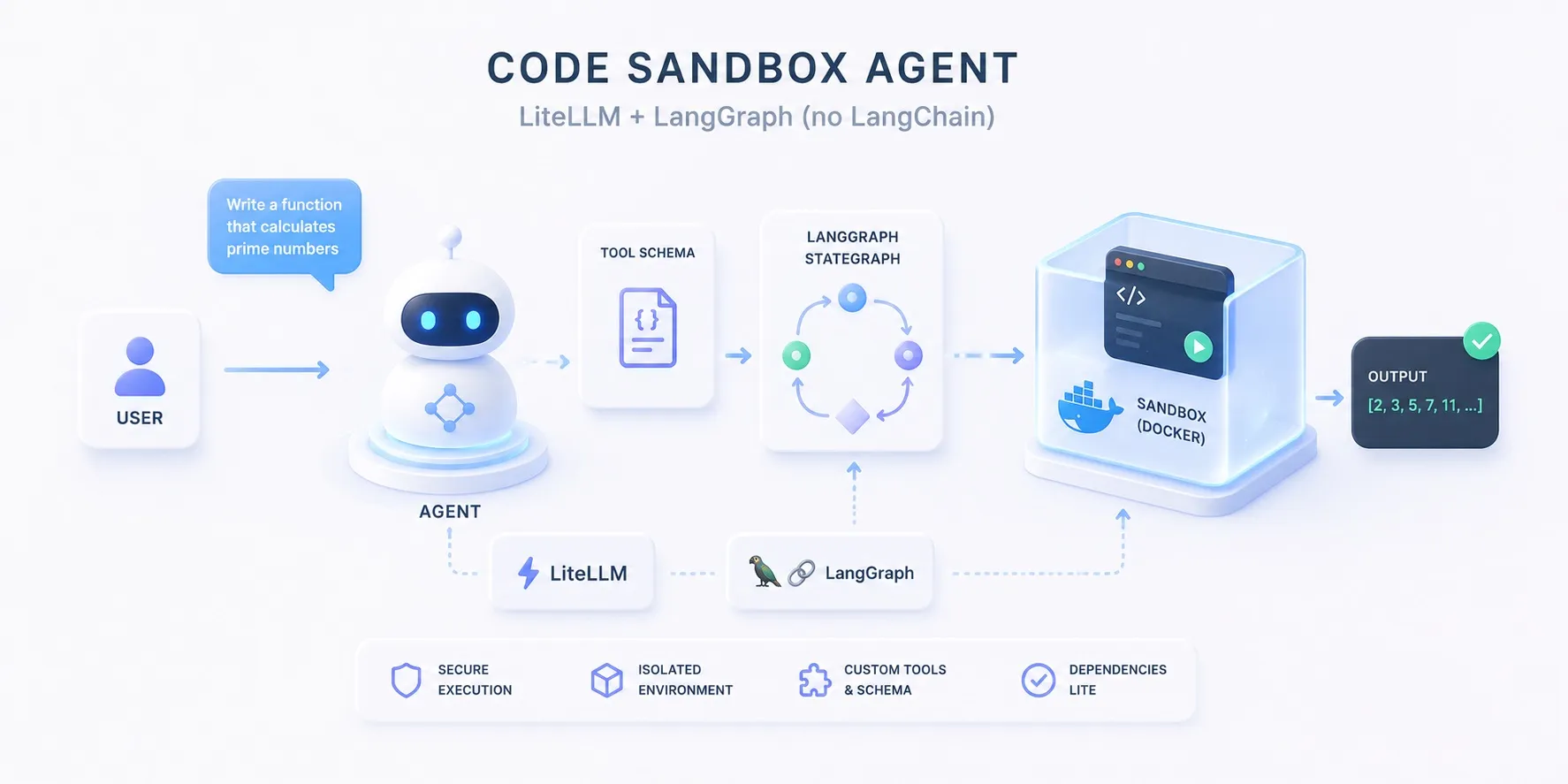
In the code-sandbox agent we built the loop with two lines of create_agent.
This post rebuilds the same agent without LangChain.
The only dependencies are LiteLLM (model routing) and LangGraph (the loop runtime).
Why this composition works at all is covered layer by layer in Dropping LangChain;
here we turn that “option B” into a working agent.
What we’re building
The behavior is exactly the original’s.
- Given a task that needs computation, the model writes Python,
- the
run_pythontool runs it in an isolated Docker container and hands back the output, - and the model reads that and answers.
flowchart LR
  q["task — 30th Fibonacci?"] --> model["Model"]
  model -- code --> tool["run_python"]
  tool --> box["docker run — isolated container"]
  box --> out[("result · error")]
  out --> model
  model --> ans["answer"]
  class model roleModel
  class tool roleTool
  class out roleSource
Only the wiring changes.
- Four dependencies (langchain, langchain-litellm, langgraph, litellm) become two (langgraph, litellm)
- A hand-written JSON schema instead of the
@tooldecorator StateGraphnodes + a conditional edge instead of the prebuilt loop- The sandbox (
docker run+ isolation flags) doesn’t change by a single character
Reading the code
The overall structure
app.py boils down to two nodes and one edge.
call_model()calls the model through LiteLLM,- when the model requests tools,
call_tools()dispatches them by hand, - and
route()loops between the two until there’s no tool request.
flowchart TB
  q["task (sys.argv)"] --> build["build_graph() — StateGraph wiring"]
  build --> model["call_model — litellm.completion"]
  model -- tool_calls --> tools["call_tools — hand dispatch"]
  tools --> dock[("docker run · python:3.12-slim")]
  dock -- stdout/stderr --> tools
  tools --> model
  model -- no tool request --> msg["message_text(content)"]
  msg --> out["print → stdout"]
  class model roleModel
  class tools roleTool
  class dock roleSource
The detailed structure
RUN_PYTHON — the hand-written tool schema
With LangChain, @tool derived the schema from the function signature and docstring.
Here the schema is your code.
The description inherits the docstring’s job: it’s what the model reads to decide when to reach for code.
RUN_PYTHON = {
    "type": "function",
    "function": {
        "name": "run_python",
        "description": (
            "Run a snippet of Python and return its stdout/stderr. "
            "The code executes in an isolated, throwaway Docker container — "
            "no network, capped memory/CPU — so it can't touch the host. "
            "Use print() to surface results, and stick to the standard library."
        ),
        "parameters": {
            "type": "object",
            "properties": {
                "code": {"type": "string", "description": "Python source to run."}
            },
            "required": ["code"],
        },
    },
}
The run_python() function itself is identical to the original’s — it pipes code into a flag-guarded docker run, and the sandbox doesn’t care which framework called it.
call_model — the model node
flowchart TB
  q["task (sys.argv)"] --> build["build_graph() — StateGraph wiring"]
  build --> model["call_model — litellm.completion"]
  model -- tool_calls --> tools["call_tools — hand dispatch"]
  tools --> dock[("docker run · python:3.12-slim")]
  dock -- stdout/stderr --> tools
  tools --> model
  model -- no tool request --> msg["message_text(content)"]
  msg --> out["print → stdout"]
  class model roleFocus
  class tools roleTool
class dock roleSource- Calls
litellm.completiondirectly — noChatLiteLLMadapter; routing is still the oneMODELenv var - Passes the schema along on every call via
tools=[RUN_PYTHON] - Appends the reply as a dict to the state list — no message types, no reducer
def call_model(state: State) -> State:
    """Agent node: one LiteLLM call with the conversation so far + the tool."""
    resp = litellm.completion(
        model=os.environ.get("MODEL", "claude-opus-4-8"),
        messages=state["messages"],
        tools=[RUN_PYTHON],
        temperature=0,
    )
    msg = resp.choices[0].message.model_dump()
    # Drop null fields (e.g. function_call) so the resent message stays clean.
    msg = {k: v for k, v in msg.items() if v is not None}
    return {"messages": state["messages"] + [msg]}
call_tools — the tool node, dispatched by hand
flowchart TB
  q["task (sys.argv)"] --> build["build_graph() — StateGraph wiring"]
  build --> model["call_model — litellm.completion"]
  model -- tool_calls --> tools["call_tools — hand dispatch"]
  tools --> dock[("docker run · python:3.12-slim")]
  dock -- stdout/stderr --> tools
  tools --> model
  model -- no tool request --> msg["message_text(content)"]
  msg --> out["print → stdout"]
  class model roleModel
  class tools roleFocus
  class dock roleSource
Everything the prebuilt did for us gathers here.
- Pulls the name and arguments out of
tool_callsand JSON-parses them - Picks the function by name — more tools means more branches here
- Hands each result back tagged with
tool_call_id— the key the model uses to match answers to requests
def call_tools(state: State) -> State:
    """Tool node: dispatch every requested call by hand and tag each result
    with its tool_call_id so the model can match answers to requests."""
    results = []
    for call in state["messages"][-1]["tool_calls"]:
        args = json.loads(call["function"]["arguments"] or "{}")
        if call["function"]["name"] == "run_python":
            output = run_python(args.get("code", ""))
        else:
            output = f"Error: unknown tool {call['function']['name']}"
        results.append({"role": "tool", "tool_call_id": call["id"], "content": output})
    return {"messages": state["messages"] + results}
route and the graph wiring
flowchart TB
  q["task (sys.argv)"] --> build["build_graph() — StateGraph wiring"]
  build --> model["call_model — litellm.completion"]
  model -- tool_calls --> tools["call_tools — hand dispatch"]
  tools --> dock[("docker run · python:3.12-slim")]
  dock -- stdout/stderr --> tools
  tools --> model
  model -- no tool request --> msg["message_text(content)"]
  msg --> out["print → stdout"]
  class model roleModel
  class tools roleTool
  class dock roleSource
class build roleFocus- The state is a
TypedDictwith a singlemessageslist route()sends the flow to the tools when the last message hastool_calls, and to the end when it doesn’t- The graph
create_agentused to build internally is compiled right here — the whole shape of the ReAct loop fits in ten visible lines
class State(TypedDict):
    # Plain OpenAI-format message dicts — no message classes, no reducer.
    messages: list

def route(state: State) -> str:
    """Conditional edge: run tools if the model asked for them, otherwise stop."""
    return "tools" if state["messages"][-1].get("tool_calls") else "end"

def build_graph():
    """Wire the ReAct loop explicitly: model -> (tools -> model)* -> end."""
    graph = StateGraph(State)
    graph.add_node("model", call_model)
    graph.add_node("tools", call_tools)
    graph.add_edge(START, "model")
    graph.add_conditional_edges("model", route, {"tools": "tools", "end": END})
    graph.add_edge("tools", "model")  # after running tools, think again
    return graph.compile()
main() is five or six lines that feed the graph a question and print the last message.
The agent.invoke({"messages": […]}) call looks exactly like the original’s.
Same LangGraph runtime, after all.
The implementation
The full code, wired with just LiteLLM + LangGraph.
The sandbox isolation flags, the Dockerfile, and how to run it are identical to the original post.
samples/docker_2June 28, 2026The key parts
- The schema is the docs
- The
descriptionfield does what@tool’s docstring did. - You now write the manual the model reads, yourself.
- The
- The dispatch is your code
- Name branching, argument parsing, and
tool_call_idmatching all sit in plain sight — easy to slot in logging or custom policy.
- Name branching, argument parsing, and
- The state is just a list
- Plain OpenAI-format dicts appended together, so you can print the conversation at any point as-is.
- The sandbox is framework-agnostic
run_pythonand its isolation flags are unchanged — the isolation comes from the Sandboxing design, not from the wiring.
To weigh the two versions side by side,
see Dropping LangChain; for the two-line create_agent build, see the original tutorial.